
September 16, 2026Excellence in Action: Part 2 | Ms. Ali Robinson, Grade 3 Language Arts
Excellence in Action: A Series
Inside the Classrooms of Aberdeen Hall
What does exceptional teaching actually look like in practice? In this series, former High School Principal Grant Ozechowski visits classrooms across all three divisions to observe authentic, everyday learning and ask students directly what makes their teachers great. Each feature highlights how our faculty bring the core pillars and key actions of Aberdeen Hall’s Strategic Direction to life.
Strategic Pillar: Our Program
Key Actions: Engage students in authentic, experiential learning. Enrich learning through experiences that connect classroom study with real-world contexts, empowering students to reflect on their observations and apply their learning in new situations, cultivating curiosity and lifelong learning.
The timer on the board starts at two minutes, and it has already started to tick its way down. Three simple instructions are noted:
1. Settle Your Body
2. Put Away Your Things
3. Get Ready to Start
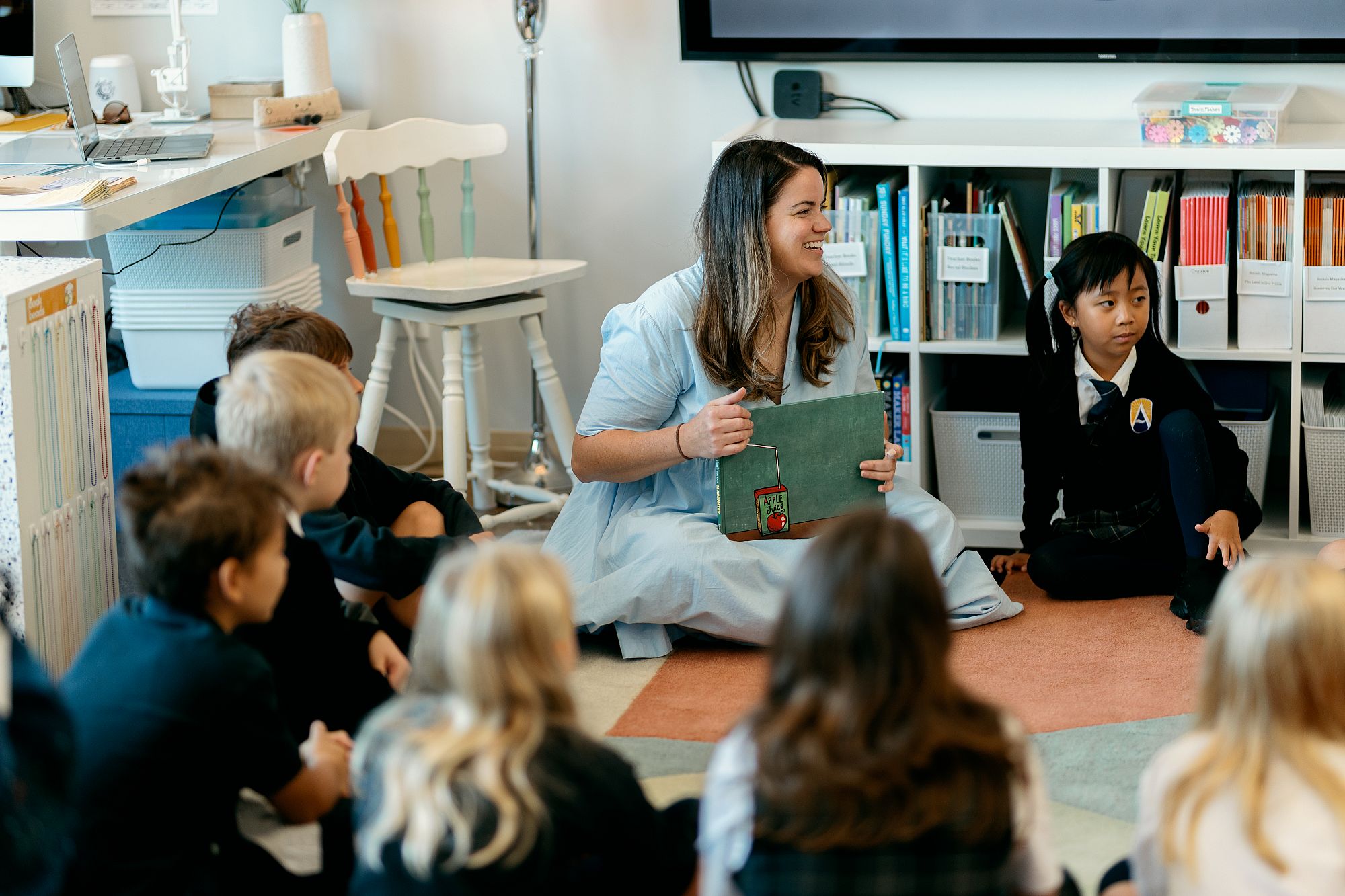
The classroom is buzzing with Grade 3 energy, as Ms. Robinson’s class has welcomed the students from the class across the hall. As a first-time visitor, I imagined that twice the number of students would result in twice as much buzz. However, what I discovered is quite the opposite. These kids know what they are doing, and they are motivated to get things moving. With no further explicit instruction from Ms. Robinson, they find their groups, rearrange their chairs, and open their notebooks. “We’re pretty good at this,” one of the students tells me confidently. I can see that.
Before the timer has the chance to elapse, Ms. Robinson stands and asks, “All set?” A chorus of students replies as one, “All set!”
Ms. Robinson takes a moment to congratulate the Grade 3 students for their efficiency in getting things rolling. “Today you didn’t even need the full two minutes! Let’s start with a mini-lesson on vocabulary.” She goes on to explain that during the previous class, the group had come upon a word they weren’t familiar with. As she speaks, she writes the word “Tarpaulin” on the board. After penning the word, Ms. Robinson takes predictions from the students. “What do you think it means?” she asks. The students provide a few predictions, after which she provides the dictionary definition and then reads the word in a sentence.
It might seem like a pretty standard set of instructions, but Ali Robinson’s five-minute mini-lesson here serves as a model for what the students will be doing moments later when they break into their smaller groups. Her example demonstrates the process of asking a question, making predictions, clarifying an answer, and using newly acquired knowledge. It’s also a demonstration of their teacher’s commitment to lifelong learning. Not even she knows every word in the dictionary!
“Put your thumb on your nose if you know what to do!” Ms. Robinson says. The students indicate the affirmative as they launch into their small group activities. Some stay in her room, others follow Ms. Welch across the hall.
I jam myself into one of the tiny Junior School chairs and join one of the clubs. I soon learn that every group has a different book, each carefully selected for reading level, interest, and genre. All the groups are student-led, with Ms. Robinson rotating as needed.
“Who wants to go first?” one of the boys asks. “Did you want to start?” They start flipping through their notebooks to find the most recent page. The girl to my left begins, “My first word is pavilion, it’s on page 84, and I think it means gathering place.” “That’s a great word,” says the boy across from her, “I had that one too. My guess is, cabin.” Then the third member of the group grabs the dictionary and together they search for their word. “Here it is—pavilion: a large sumptuous tent.”
Pencils scratch definitions into their notebooks. I tell them maybe sumptuous would make a good word for Ms. Robinson to tackle the next day, because none of us know what that means! The kids grin and continue with their exercise, sharing their words, asking questions, and looking up definitions.
"We’re kind to each other, and we’re getting pretty good at not disagreeing even if we have different ideas. We’re also getting a chance to work as a team and build resilience."
I must say, it is the first time I've ever heard the word resilience uttered by a Grade 3 student. But, in this case, I can see how it fits.
Each of these groups is working on reading comprehension and communication. Their vocabulary will improve, and their appreciation for literature will develop too. However, the greatest lessons won’t be as obvious: skills like the ability to wait their turn, to share opinions, to disagree politely, and to appreciate different perspectives. They also learn to hold themselves accountable, because the activity is no fun if the group members are unprepared. It’s a microcosm of what some would call “the real world” taking place in the safe confines of Ms. Robinson’s classroom.
Clearly, this is an activity that has been painstakingly planned, diligently modelled, and carefully facilitated. I ask Ms. Robinson what advice she’d have for teachers embarking on a similar path. “Collaborate with your peers. Reflect on every class; ask what worked, what didn’t. Plan ahead, and build lots of resources so you can spend time during class with the students, and use your imagination. Oh, and don’t be afraid to tinker with things,” she replies.
My visit ends all too early, and I soon find myself in the doorway. I glance back once more to take one last visual snapshot of the lesson I’ve been a part of moments before. There are no rows. No hands in the air waiting for questions to be answered. No teacher standing at the front awaiting their attention. Instead, there are leaders sharing ideas, teammates encouraging one another, and students smiling as they discover the answers themselves. This is learning as it should be; a place where students can be the experts, sharing ideas and questions freely, a place where continuous progress is valued over perfection, and where the teacher encourages learning to reach beyond the walls of the classroom.
AdmissionsApplications to Aberdeen Hall are accepted year round and are increasingly competitive.
At Aberdeen Hall, we seek to admit well-rounded students who choose to be at our school. We are looking for students who demonstrate leadership through academic performance, involvement in co-curricular activities and civic engagement. We care about our students and seek those who value education and are prepared to enrich our incredible school community.