
October 15, 2026Excellence in Action: Part 6 | Ms. Brianne Niles, AP Psychology 11
Excellence in Action: A Series
Inside the Classrooms of Aberdeen Hall
What does exceptional teaching actually look like in practice? In this series, former High School Principal Grant Ozechowski visits classrooms across all three divisions to observe authentic, everyday learning and ask students directly what makes their teachers great. Each feature highlights how our faculty bring the core pillars and key actions of Aberdeen Hall’s Strategic Direction to life.
Strategic Pillar: Our Programs
Key Actions: Designing Dynamic and Responsive Lessons; Building Differentiated, Personalized Learning
"Be gone, J. Evans Pritchard, Ph.D.!" Famous words uttered by John Keating (played by Robin Williams) in Dead Poets Society. Next, John goes on to demand that his students rip a page from their poetry textbook. One by one, the boys begin to tear at their textbooks, some crinkling and crumpling the page, others tearing carefully to avoid undue damage to the book.
It’s a pretty iconic scene, worth a watch if you haven’t seen it. However, in this context, the AP Psychology class is not viewing this film to extoll the virtues of lyrical poetry. Here, Ms. Niles is using Keating’s teaching style as a hook to her lesson.
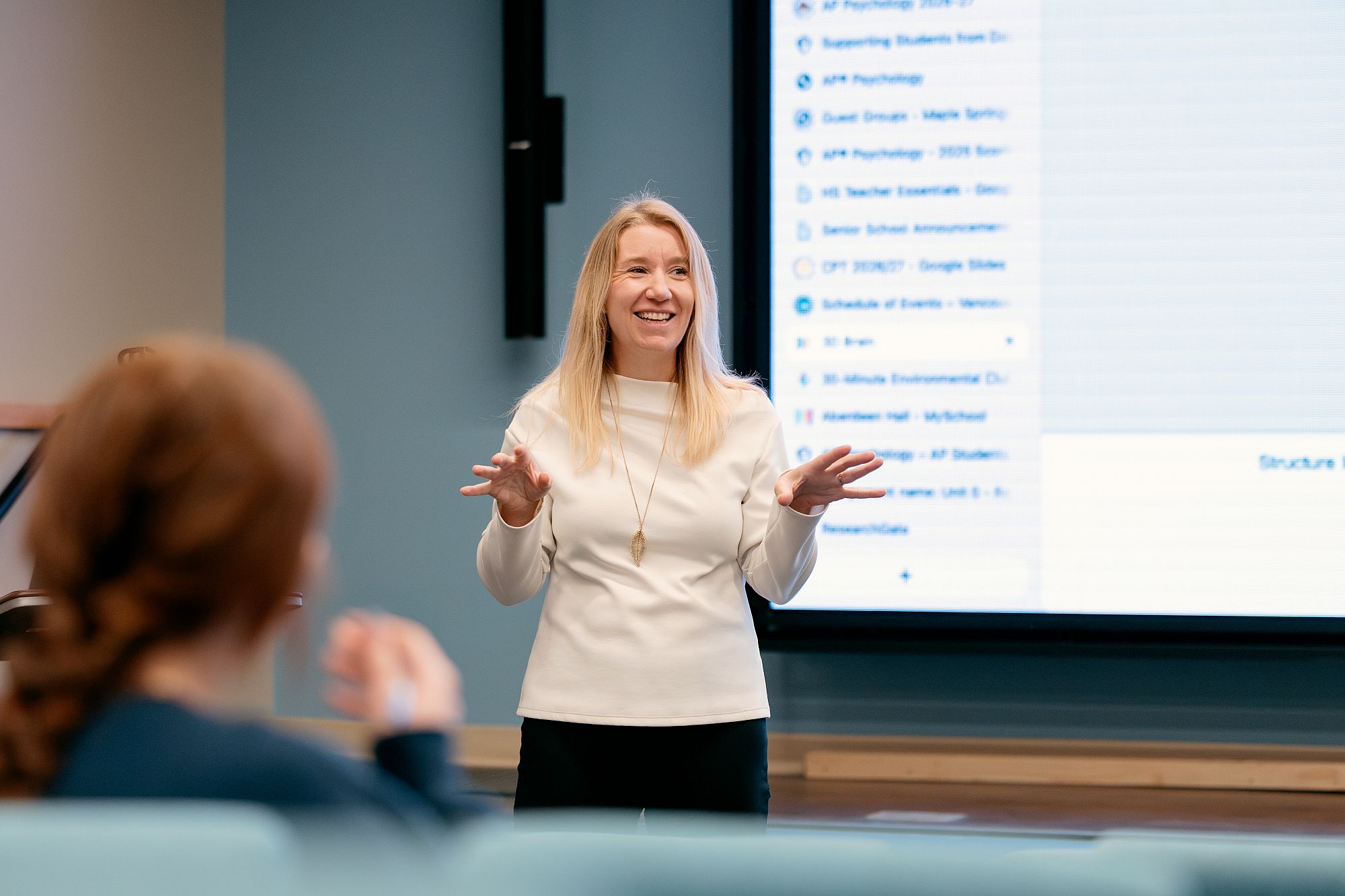
“If you think Keating would use proficiency scales, stand on this side of the room. If you think he’d opt for percentage grades, move over here,” she asks as the students begin to shuffle.
Next, Ms. Niles asks, “If you think he’d use a behaviour chart, move to the left. If you believe he’d have a quiet conversation, step to the right.”
Finally, she states, “Would he support Vygotsky or sage-on-the-stage instruction?” as her students relocate themselves accordingly.
It’s called 'vote with your feet,' and it’s a good way to get kids moving—especially when they're teenagers, it’s a sunny day, and it’s after lunch! But Ms. Niles has grander designs for her opening activity. She wants to connect the vocabulary they’ve been learning recently with real-life situations. After each question, students are asked to justify their vote by explaining the psychological reasoning behind their choice. They defend their positions with statements like, 'Keating would opt for intrinsic motivation over extrinsic,' and 'He’d choose self-efficacy and individuality over groupthink.'
Soon, the class moves on to the next activity, where students work on building their own schools based on the psychological theories they believe will make for the greatest student experience. As a visitor, I am intrigued by the ownership each student has for their project. They work in small groups, sharing their ideas and explaining their reasoning. The conversation shifts from John Keating’s classroom to the imaginary schools each student has created on paper. Now, the words they’ve learned in their AP Psych textbook are coming to life in a meaningful way. It is this authentic, personal connection that students find most engaging in Ms. Niles’ classroom.
Intrigued to know more, I ask the students what makes her classroom excellent. Their feedback is incredibly powerful:
"She wants to know who we are as people, she asks questions and listens to us. Then, she designs lessons with our stories in mind."
"She’s not afraid to be vulnerable herself, using examples from her own life, her own failures and disappointments."
"She’s on our team, not trying to trick us, and she adapts her lessons so we can all connect with the content... she has high expectations, she tries hard, and I learn because I can apply the stuff to my life."
I am still digesting this praise when Ms. Niles moves on to the final phase of the lesson: a dramatic reading of Walt Whitman’s “A Noiseless Patient Spider.” The students turn their attention to the screen as a faceless voice recites Whitman’s verses.
It’s a quick reading, probably about 50 seconds long, after which Ms. Niles closes the class with a simple set of instructions: “For tomorrow, figure out why I picked this poem, and explain how you think it relates to John Keating.” With that, the students start packing their things.
For some, the task will send them diving into Google, looking up definitions of words like gossamer and filament. Others will explore poem summaries and interpretations. Many will sit down to contemplate things on their own, jotting down their thoughts in their notebooks. Whichever route they choose, they will all come back to class with something worth sharing. Along the way, they might discover an unexpected connection, spin a new hypothesis, or even uncover the wonders of a different Whitman poem. Who knows, a few may even gain some deeper existential awareness from the process. It is a wonderful poem after all.
In any case, they will all be curious, and they know their discoveries will be heard and validated. They understand that their teacher will take their insights, and use them to design the next learning activity. Ms. Niles knows that this is the key for her students. When they are curious, they are learning, and when they are cared for, they try harder. That’s what makes these lessons truly excellent. That is also what academics like Evan Pritchard, Ph.D., could learn from Ms. Niles.
AdmissionsApplications to Aberdeen Hall are accepted year round and are increasingly competitive.
At Aberdeen Hall, we seek to admit well-rounded students who choose to be at our school. We are looking for students who demonstrate leadership through academic performance, involvement in co-curricular activities and civic engagement. We care about our students and seek those who value education and are prepared to enrich our incredible school community.